| Protest in Stroud | |||
 |
|||
| Julian
interviewed by Tamsin Treverton Jones, published in Memories of Stroud,
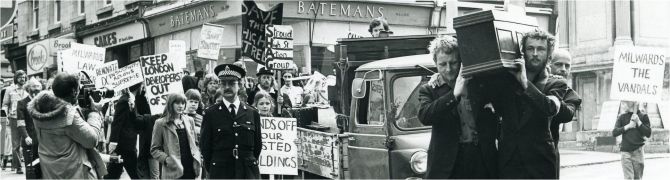
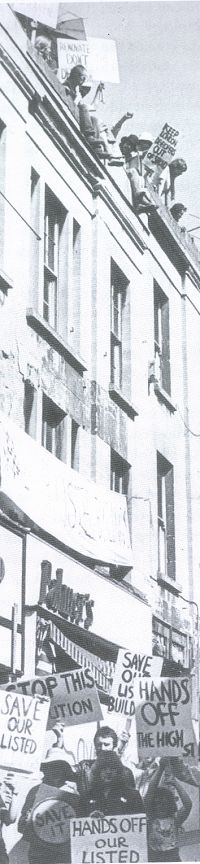
2005: When I first moved to the Stroud Valleys in 1972 I was bowled over by the scenery and the architecture. I remember going to Stroud, driving along Merrywalks, seeing the old Police Station and saying to my wife. “If anyone every tries to pull that building down, I’m going to move away”. I just loved it instantly and was totally horrified when, six months later, it was all boarded up for demolition. The council had the brilliant idea of putting a new road slap through the middle of Stroud. The inner ring road was to run from Merrywalks, knocking down the old police station and the British School, wind its way up the hill to Lewis’ the electrical shop and cut across the top of the high Street knocking down another six listed buildings and on to join up with London Road. Local outrage prevailed, spear-headed by the Stroud Campaign Against the Ring Road (SCARR). Following a public enquiry the Secretary of State took two years to find in favour of the campaign. It demonstrated that people of Stroud did have power; the newcomers had found their voice. In 1976 a tenant in a cottage at Westley Farm called Tom Bermingham found five derelict shops, all listed buildings, in Stroud High Street. They were owned by Milwards the shoe company who had been refused permission to demolish and redevelop the site. Tom, who was concerned about unemployment in Stroud, approached the owners, hoping to rent one of the shops for the benefit of the community. He set up a grant-aided café called Starters staffed by the unemployed, which became a real focus for the community. The buildings had been empty between 1976 and 1980. The council became concerned about their safety and served a “Dangerous Structures Notice” on the owners under the 1936 Public Health Act. This gave Milwards the choice of making the buildings safe or demolishing them within three months. Therefore by simply neglecting the buildings they had achieved their original aim. At this point I started organising demonstrations. We carried a coffin around the town protesting against the decision. Tom & I and several others took over the ‘at risk’ buildings and sat on the roof. We knew that the three month deadline was imminent and it was only a matter of time before a confrontation took place. At about 10.30 am on Wednesday May 14th 1980, four demolition men arrived and began pulling off the slates. They soon abandoned their project, heavily out-numbered by 25 demonstrators, in a brief roof-top tussle. The council, concerned at the risk of the building collapsing, blocked the High Street with two ancient dust-carts at the top and bottom of the High Street. The local paper devoted the whole of its front page to “The siege of the High Street”. The confrontation came to an end on the Friday when a court injunction was granted staying demolition. |
Three of us,
Steve Tomlin, Mike Goodenough and I went to see a lawyer called Peter
Hankins who agreed with us that where two acts of parliament were in
direct conflict we stood a good chance of success in the High Court for
a Judicial Review. An open
public meeting in Starters Café led to the formation of the Stroud High
Street Action Group (SHAG). We produced regular newsletters and I agreed
to fund an action in the High Court.
Lord Donaldson and Lord Woolf instructed Stroud District Council
to reconsider its former decision and consider the alternatives to
demolition. Unfortunately
the council decided they were not going to budge.
After long delays a public enquiry decided that the buildings
were capable of restoration. We had won a notable victory.
The High court action had established that the provision for
demolishing a dangerous structure could not take precedence over the
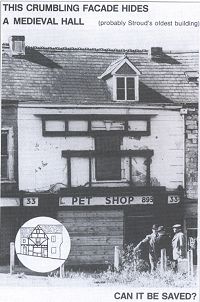
protection of a listed building under the Town and Country Planning Act. Our conservation lobby took a lot of flack from locals and in the press for negativity and stopping progress. A new direction was needed. We formed the Stroud Preservation Trust and I was its first Chairman. Project number one became known as the Medieval Hall at the top of Stroud High Street. The council gave us three “unsavable” ancient listed buildings at no cost. We set up a government aided community programme and spent 18 months putting the building to rights. The historian and archeologist on our board of trustees had worked out that the building was probably the oldest in Stroud (1539). The project was a great success, making a considerable profit and proving that conservation did not always have to be negative. In 1984, our second project was No. 55 High St. This was a crumbling Georgian building, whose classical façade was marred by an ugly modern shop front. We bought it for £70,000 and turned it into a high Street shop with four flats above. Behind we created Withy’s Yard with a café, three retail units and an alternative health centre. The two projects made serious money. The trustees decided that we could afford to turn our attention to other worthy projects where profit was a lower priority. The Goods shed at Stroud Station was in the way of British Rail's plans to enlarge their car park. It was not listed and the slate roof had been taken off. We negotiated a forty year lease with British Rail and before an end user had been identified we began drawing up a structural restoration plan. With an election imminent the Conservative Government were looking for a high profile photo opportunity in the West of England. Environment Minister William Waldegrave was sent of a whistle stop tour with his friend Macalpine (of the construction firm). They arrived at Stroud Station in Macalpine’s restored Edwardian train. In a brief ceremony with speeches from various dignatories I was formally handed a large ceremonial brass key. (The shed had no doors). How odd that my anarchic past had somehow ended with accolades form a Conservative Government Minister. |
  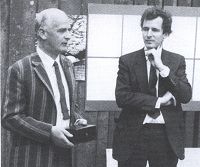 Waldegrave presents ceremonial keys |
|